Ethiopia 2026 – DW, Nigrizia
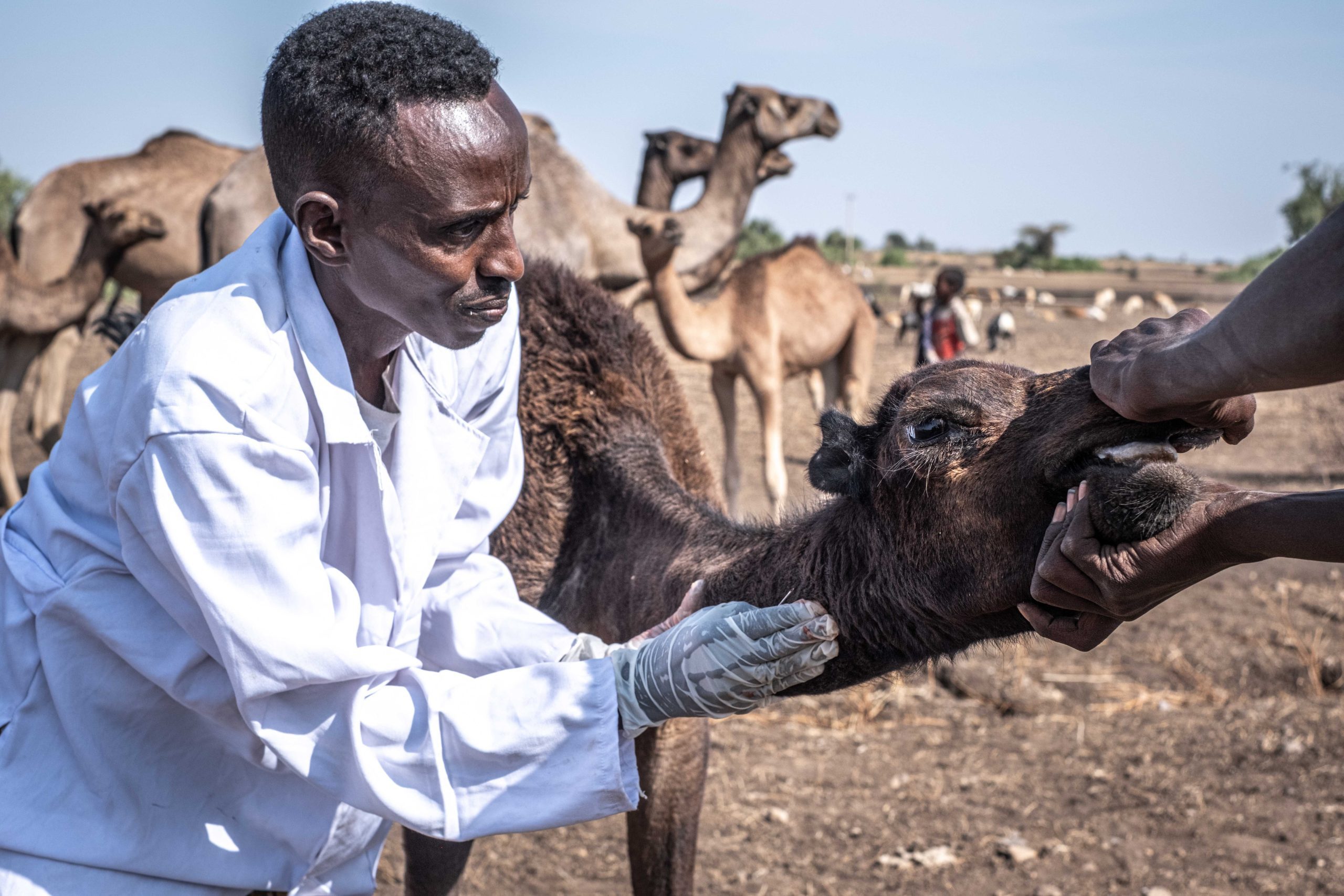
On the arid outskirts of Yallo, in Ethiopia’s Afar region, dozens of pastoralists gather with their livestock around a modest veterinary structure standing alone in the dust. Men struggle to restrain restless zebu cattle and camels. Veterinarians move quickly, syringes in hand, vaccinating before the animals can break free.
“They complain, but it’s for their own good,” one Afar herder says with a smile, holding tightly to a camel’s head.
For the Afar, livestock is not just property. It is life. Camels, cattle and goats provide milk, meat, income, social status and security. In Ethiopia, livestock accounts for roughly 46% of agricultural GDP. In Afar, where more than 90% of households rely on pastoralism, animal health directly determines whether families eat, trade, send children to school — or survive.
This borderland between Afar, Tigray and Amhara was one of the main frontlines during the Tigray war, which formally ended in 2022. Many Afar families were displaced. Herds were looted, scattered or killed. Veterinary services — already limited — collapsed entirely.
“Before the conflict, I had camels. During the conflict they were looted and died,” says Mohammed Ibrahim Maar, who fled to neighbouring Amhara and has only recently returned. “Now we are slowly rebuilding, but we fear the fighting could start again.”
That fear is not abstract. In recent months, renewed clashes have been reported in nearby areas, reviving anxiety across communities that are only beginning to recover.
Today, vaccination and veterinary treatment campaigns are slowly resuming with support from NGOs and local authorities. Diseases such as PPR, pasteurellosis and sheep and goat pox remain endemic in pastoral systems and can wipe out herds within weeks if not treated promptly. Vaccinations must be carried out periodically — often every six months — and sick animals treated immediately before infections spread irreversibly through mobile herds.
“When livestock dies, people lose everything,” says local veterinarian Gemal Said. During the conflict, he explains, the interruption of vaccination campaigns led to disease outbreaks that further devastated already weakened communities.
In Afar, the link between animal health and human survival is direct. If animals are healthy, families have milk, meat and income. If herds decline, food insecurity rises.
Climate stress adds another layer of vulnerability. Recurrent droughts and extreme weather events periodically hit this already arid region, reducing pasture, shrinking water sources and weakening animals, making them more susceptible to disease. In such conditions, veterinary care becomes not just a technical service but a stabilising force.
For Afar pastoralists, vaccinating a camel or treating a cow is not a minor intervention. It is an act of protection — against hunger, against poverty, and increasingly, against the uncertainty of a region where the shadow of conflict has not fully disappeared.


